for restaurant teams — closed B2B intensive
one-day intensive
Sommelier day — Michelin-track pairing intensive
Twelve exceptional Chinese teas, three guided plate trials, and one day of focused practice for working sommeliers who want to bring precise, culturally grounded tea service to starred kitchens. Led by our team in Berlin Mitte.
- When
- 2026-10-18 · 8 hours
- Where
- Berlin · Mitte studio
- Price
- €340
the arc of the day
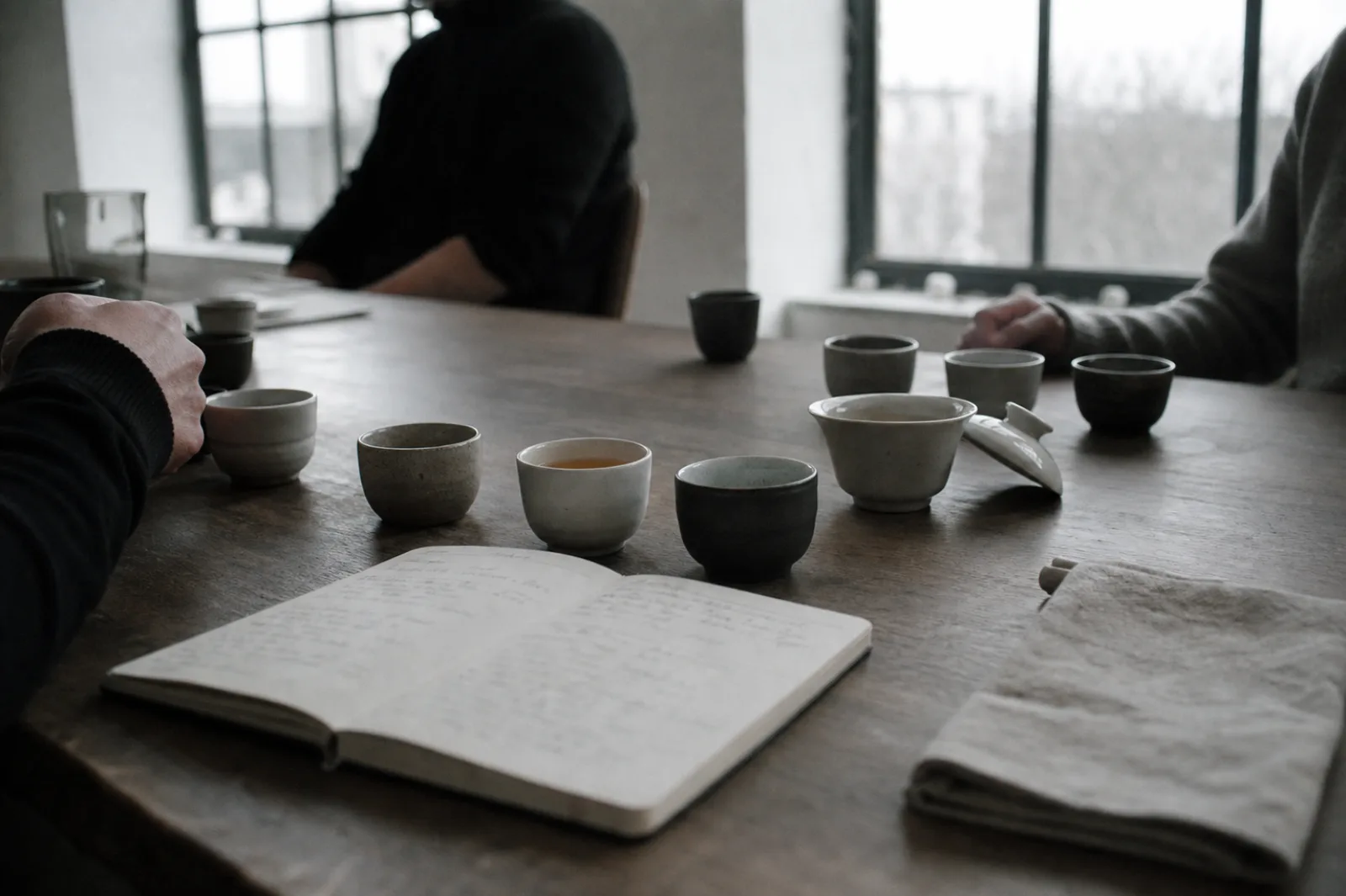
The morning begins with a quiet pour — a silver needle Bái Háo Yín Zhēn (白毫银针) that sets the register for the day. The group gathers around the tasting table. The studio light is soft, the morning October air cool through the courtyard. No more than ten sommeliers share the space.
We move through three sips before the first plate. Shēng Pǔ’ěr (生普洱) from a 2018 Bingdao pressing teaches tracking evolution across infusions — the way a well-stored cake softens its young bitterness into honeyed wood. Then a flight of Phoenix Mountain dancong: a Mí Lán Xiāng (蜜兰香) with its honey-orchid lift, a roasted Yā Shī Xiāng (鸭屎香) that reads like stone fruit and ginger. Tasting notes are written in silence; temperature, pour height and the angle of the gaiwan lid are corrected between infusions.
Lunch is itself a trial. Three small plates, each paired with a single tea. The first plate — a cold-smoked trout with fennel — meets a smoked lapsang souchong from Tongmu village. The pairing shows how the tea’s longan sweetness pulls the smoke forward without overwhelming the dish. The second plate, a celeriac mousseline with pickled mustard seed, is matched with a 2015 Wò Duī (渥堆) ripe pǔ’ěr from Menghai whose earthy sweetness wraps the acidity. The third, a custard with preserved plum, sits against a lightly oxidised Fujian white tea that hums like pear skin. By the end of lunch, the matrix is no longer abstract.
Afternoon is given to rehearsing service. Each sommelier presents a pairing rationale to the group — notes, origin story, extraction method. The discussion steers the language toward the material differences that matter in a dining room: what a guest tastes when the tea is brewed with 85 °C water versus 95 °C, how the liquor changes after thirty seconds of resting, why a teapot’s shape shapes the experience. The final hour is open conversation over a gentle Huangshan Máofēng (毛峰), laying down what’s been absorbed into muscle memory.
Members of tea.community receive a €40 discount code when registering; full details are sent after purchase. Many participants continue their study through tea.school — the intensive serves as a strong practical complement to the deeper theoretical modules there.
What you get
-
twelve curated Chinese teas spanning raw and ripe pǔ’ěr, dancong oolong, lapsang souchong, white tea, and green tea
-
three guided plate-pairing exercises with printed tasting templates
-
pairing matrix workbook designed for restaurant-scale tea service
-
certificate of completion
-
take-home 30 g sample set of all featured teas from shop.thetea.app with a one-time 15 % discount code
-
post-event access to a dedicated channel on tea.community for follow-up questions and peer exchange
-
recommended reading list and tea school roadmap for continued training
practical details
-
studio address — Brunnenstraße 181, 10119 Berlin · ground floor, buzzer ‘Tea Studio’
-
dress — smart-casual, minimal scent; no heavy perfumes or colognes
-
food — small tasting plates served during the pairing trial; a light vegetarian lunch is provided
-
accessibility — step-free entrance at ground level; accessible washroom
-
language — instruction in English with Mandarin tea terms; written materials bilingual
-
kit included — personal tasting cup, kettle-side thermometer, waste-water bowl, paper notebook, and a pencil
-
weather note — October in Berlin averages 8–13 °C; the studio is climate-controlled